Different Types of Pneumatic Valves and How They Work
(Updated 14 November 2025)
Choosing the right pneumatic valve can make or break your system’s performance. In demanding industrial environments, understanding different types of pneumatic valves is essential for keeping your equipment running efficiently and safely.
Pneumatic valves control the flow, pressure, and direction of compressed air in your systems. But here’s what many technicians overlook: the valve type you select directly impacts energy costs, maintenance schedules, and system reliability.
Let’s examine how each valve type works and when to use them.
Two-Way Directional Valves (Simple On/Off Control)
Two-way directional valves are about as simple as pneumatics gets. Two ports, on or off. Think of them as light switches for compressed air. But here’s where people get themselves into trouble: they assume simple means you don’t need to worry about sizing. Wrong.
Flow capacity matters more than most technicians realise. Undersize your valve and you’ll get pressure drops that slow down your system and waste energy. Oversize it and you’ve spent extra money for no performance gain whatsoever. There’s a sweet spot, and it’s worth finding.
What you need to check: Flow coefficient (Cv) determines your maximum flow rate. Pressure drop across the valve affects everything downstream. And if you’re switching frequently, that impacts valve life expectancy in ways that aren’t always obvious until you’re replacing valves earlier than expected.
Food processing operations use two-way valves quite a bit for pneumatic conveying. The complete shutoff capability prevents product contamination during line cleaning, which is a regulatory requirement that standard throttling valves simply can’t meet. No shutoff, no compliance, no choice really.
Three-Way Valves for Single-Acting Cylinders
Three-way valves are what you want for single-acting cylinder applications. They handle both the power stroke and the exhaust control through three ports: one for air supply, one for the cylinder connection, and one for exhaust.
Operation is pretty straightforward. Energise the valve and it connects supply air to your cylinder whilst blocking the exhaust port. De-energise it and the valve isolates supply and connects the cylinder to exhaust, letting the cylinder retract under spring force or gravity or whatever external load you’ve got.
The exhaust port is more useful than it might seem initially. Install a flow restrictor in the exhaust line and you create back-pressure that slows cylinder movement. This works brilliantly in packaging applications where you need gentle product handling to avoid damage. Just throttle the exhaust and you’ve got speed control without adding complexity.
Three-way valves also use less air than four-way valves in single-acting setups. You’re only supplying air for the power stroke. Return happens through spring force or gravity, so you’re not paying to compress air for both directions. Over a year of operation, that adds up to real money saved.
Four-Way and Five-Way Valves (For Serious Applications)
Four-way directional valves handle the demanding stuff: double-acting cylinders that need power in both directions. These manage complex flow paths through internal spool or poppet mechanisms, and when they’re working properly, they create smooth bidirectional movement.
The four ports connect to pressurised air supply, cylinder port A, cylinder port B, and exhaust. When the valve shifts, it simultaneously pressurises one cylinder chamber whilst exhausting the other. Sounds simple when you describe it, but the internal engineering is actually quite sophisticated.
Modern four-way valves have features that weren’t available ten years ago. Dual pressure capability lets you run different pressures for extend versus retract cycles. Centre position options give you holding, exhausting, or pressurising functions depending on what your application needs. Some even have integrated flow control so you don’t need external speed controllers.
Five-way valves add a second exhaust port, which gives you independent exhaust control for each cylinder chamber. This improves exhaust flow and reduces back-pressure, particularly important in high-speed applications where every millisecond of cycle time matters.
Manufacturing lines often use valve banks (multiple four-way valves mounted together with integrated manifolds). This reduces plumbing complexity considerably and enables centralised control through PLC systems. Modern valve banks can control dozens of actuators from a single mounting point, though troubleshooting individual valve issues becomes more involved when everything’s integrated.
Selecting Valves for Australian Conditions
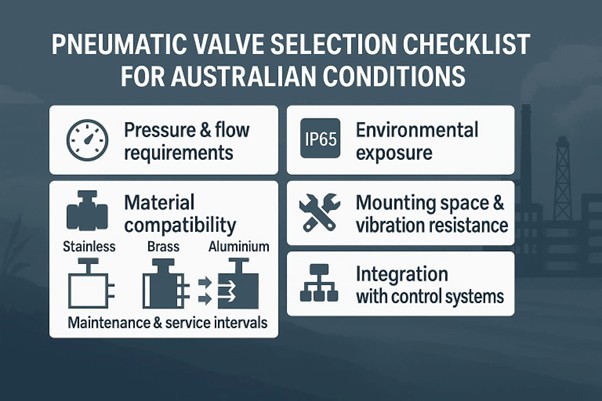
Environmental conditions across Australia vary more than most overseas suppliers realise. Coastal facilities deal with salt spray and humidity that destroys standard components. Inland operations face extreme temperature swings and dust infiltration that fouls internal mechanisms. What works in Melbourne might fail within months in Port Hedland.
Environmental ratings aren’t just nice-to-have specifications:
IP65 handles most typical industrial environments and should be considered minimum standard
IP67 is necessary for washdown areas and outdoor installations where water ingress is inevitable
Corrosion-resistant materials become essential in chemical processing and marine applications
For detailed explanation of IP rating standards, refer to the Standard IEC 60529.
Consider total cost of ownership rather than just purchase price. A quality valve operating reliably for five years costs substantially less than multiple cheap replacements plus the downtime expenses. Factor in energy efficiency too because efficient valves reduce compressed air consumption, which reduces operating costs continuously over the valve’s service life.
Things to consider during selection:
Operating pressure range and flow requirements for your specific application
Environmental exposure and what protection level you actually need
Mounting space constraints and whether orientation affects valve operation
Maintenance accessibility (can you actually reach it for service?)
Integration requirements with existing control systems
Vibration resistance becomes critical in mobile equipment and high-speed machinery. Standard valves mounted on equipment with significant vibration often fail prematurely without proper dampening or robust internal construction designed to handle constant movement.
Warning Signs Your Valves Need Attention
Most valve issues show warning signs before complete failure, assuming someone’s paying attention. Recognising these early prevents much more expensive system failures down the track.
Slow or erratic operation usually indicates contamination or wear in the valve body. Could also be partially blocked air lines or failing seals.
External air leaks suggest seal failure or loose fittings. Sometimes it’s just an O-ring that needs replacing, but leaks don’t fix themselves.
Failure to shift positions often means actuator problems or insufficient pilot pressure. Could also be contamination jamming the spool.
Regular maintenance prevents most valve failures, though it’s maintenance that often gets deferred when production schedules are tight. Change filters upstream of critical valves every three months minimum. Contaminated air destroys internal seals and causes premature wear that’s entirely preventable. Water in compressed air lines creates corrosion and freezing problems, so install proper air treatment equipment upfront rather than dealing with failures later.
Pressure testing validates valve performance during scheduled maintenance. Use a calibrated gauge (not that dodgy gauge that’s been in the toolbox for fifteen years) to verify cracking pressure, flow capacity, and internal leakage rates. Document these readings to track performance trends over time, which helps predict failures before they happen.
Here’s a maintenance schedule that actually works:
- Weekly visual inspection for external leaks and unusual sounds
- Monthly function testing and pilot pressure verification
- Quarterly internal inspection and lubrication where applicable
- Annual complete overhaul or replacement evaluation
Get Expert Valve Selection and Support
Choosing the right pneumatic valve configuration involves more variables than most people initially realise. But you don’t need to figure it all out alone. Whether you’re upgrading existing systems or designing new automation solutions, getting proper technical guidance upfront ensures optimal performance and reliability, which saves money and headaches over the system’s operational life.
Mastermac2000’s technical team understands Australian industrial conditions (because we work in them) and can recommend the ideal valve types for your specific applications. Contact us today for professional advice that’s based on actual experience rather than generic catalogue specifications.

About MasterMac2000: Your Trusted Pneumatic & Process Automation Partner.
LEADING THE INDUSTRY: Established in 1989, MasterMac2000 has grown to become one of Australia's largest privately owned pneumatic and process automation companies. We stock top-quality brands like Univer, Mack, Tolomatic, Mac, Piab, American, and Rotoflux in Brisbane.
SERVING QLD & NORTHERN NSW: We proudly service Queensland and Northern New South Wales for all your pneumatic and process equipment needs. Our mission is to provide the best pre and post-sales support while actively expanding our client base.
SOURCING HARD-TO-FIND PARTS: Not only do we stock quality components, but we also excel at sourcing those elusive, hard-to-find parts. With our extensive database and global network of contacts, getting the parts you require is as easy as a call to our highly skilled, professional sales team.
DEDICATED TO YOUR SUCCESS:
- Decades of expertise in pneumatics & process automation
- Carefully curated selection of world-class brands
- Exceptional sourcing capabilities for speciality parts
- Knowledgeable sales staff dedicated to finding solutions
- Unwavering commitment to customer service excellence
About The Author
Stuart Havill
Stuart Havill is the owner and manager of MasterMac2000, Queensland's largest privately owned pneumatic and process valve company.
With his early working career as a maintenance fitter for Boral in 1992, Stuart has spent his life in the field of pneumatics and process equipment. He gained extensive experience in plant design, maintenance, repairs, fabrication, and site management.
In 1996, he transitioned to a pneumatic sales technician role at MasterMac2000, where he excelled in key account management, providing cost-effective solutions, and managing a sales team of 9 employees.
Since 2002, Stuart has been the manager at MasterMac2000, overseeing the company's growth and establishing it as a leader in pneumatic automation and process valve engineering. His expertise spans customer training, CRM setup, industrial compressor sizing and installation, and turn-key project management.
Under Stuart's leadership, MasterMac2000 has been servicing the industry since 1988, with 5 full-time sales representatives covering northern rivers NSW, Queensland, Northern Territory, and PNG. The company prides itself on providing the best-priced solutions to all customers in the marketplace.
View Stuart’s LinkedIn profile to learn more about his expertise in pneumatics and process equipment.