Industrial Pneumatic Systems: An Overview Guide
Industrial Pneumatic Systems: An Overview Guide
Updated 22 November 2025.
When a packaging line fills thousands of bottles per hour with surgical precision, or when a mining operation’s massive conveyor systems move tonnes of material with unfailing reliability, compressed air is often the invisible force making it all possible.
Pneumatic systems represent one of industrial automation’s most elegant solutions – harnessing the fundamental physics of gas compression to deliver power, speed, and control that electric and mechanical systems simply cannot match in many applications.
The sophistication of modern pneumatic control extends far beyond the simple “push air through a tube” concept many associate with compressed air. Today’s industrial pneumatic systems operate as integrated networks of precisely engineered components, each optimised for specific performance parameters including:
- response time,
- force output,
- environmental resistance, and
- energy efficiency.
The Fundamental Principle: How Pneumatics Harnesses Physics
Pneumatics works on a principle that’s surprisingly straightforward – compress air into a smaller space and you’re storing energy, just like winding up a spring.
Boyle’s Law explains what’s happening:
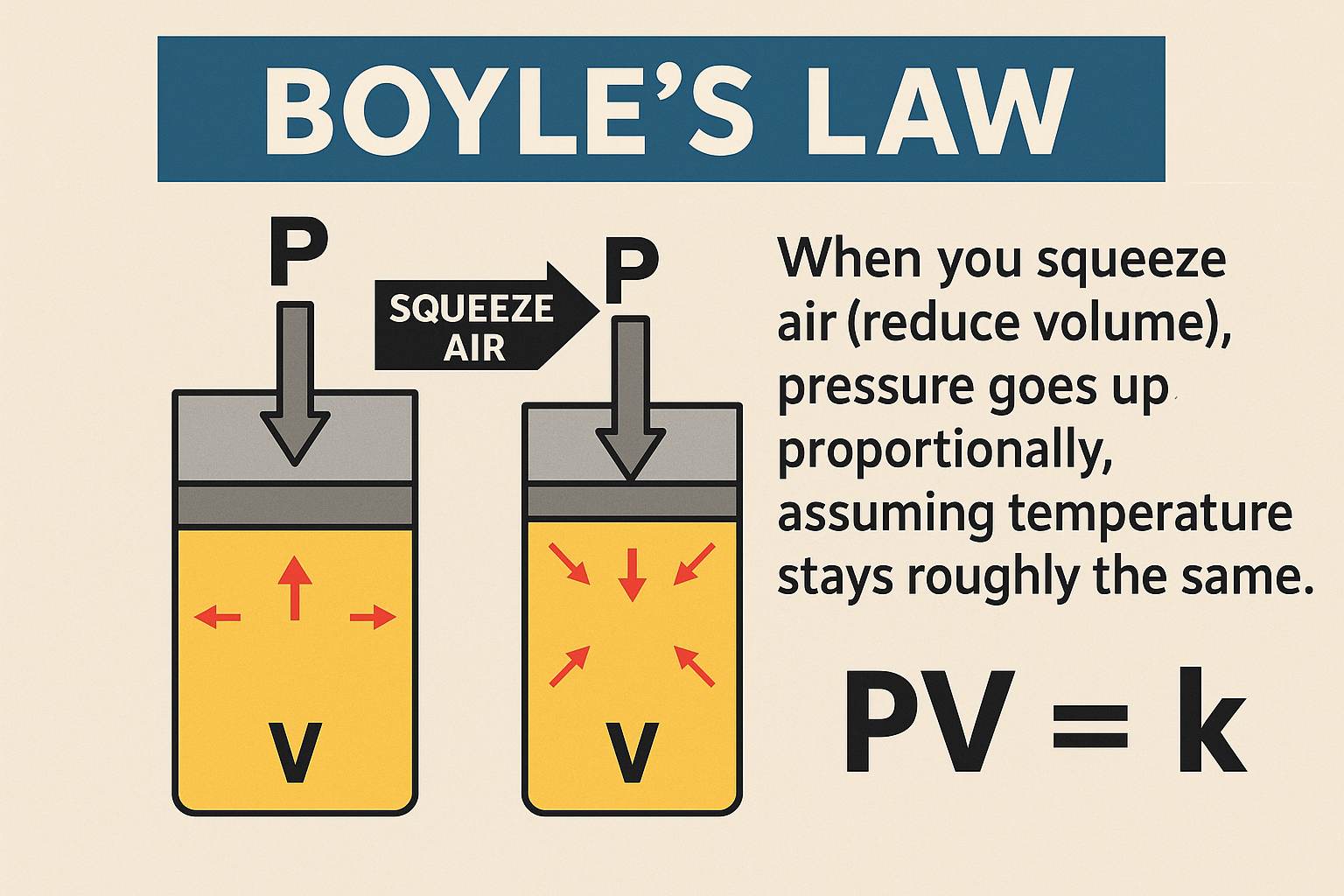
When you squeeze air (reduce volume), pressure goes up proportionally, assuming temperature stays roughly the same. It’s written as PV = k, though most technicians care more about what this means practically than the equation itself.
What makes this interesting from an engineering standpoint is how different this is from hydraulics. Hydraulic fluid doesn’t compress much – it’s nearly incompressible – so when something goes wrong, you get dramatic failures.
Air, being compressible, acts like a built-in shock absorber. Push too hard against a pneumatic cylinder and the air compresses rather than breaking something expensive.
Engineers exploit this characteristic for variable force control. Want less force? Lower the pressure.
Need more oomph? Crank it up.
Trying to do that smoothly with a mechanical system is near impossible which makes us appreciate why compressed air became indispensable in manufacturing.
Here’s a practical example: take a 50mm bore cylinder running at 6 bar. Theoretically, you’re looking at roughly 1,178 Newtons of force. But theory and practice don’t always shake hands. Friction losses, seal drag, dynamic loading – all these real-world factors mean you’ll want to oversize your calculations by 20-30% for reliable performance.
The Anatomy of a Modern Pneumatic System
Industrial pneumatic setups aren’t just “hook up an air compressor and go.” They’re integrated systems where each piece affects everything downstream. Miss one component or underspec another, and you could spend months chasing performance issues.
Air Preparation & Source: The Foundation of Reliability
Your compressor might be the muscle, but air quality determines whether your system lives for decades or dies within months. Straight compressed air is nasty stuff – loaded with moisture, oil vapour, rust particles, and whatever else was floating around when it got sucked in.
That’s where FRL units earn their keep. The filter takes out the nasty stuff (and there’s more of it than you’d think), the regulator keeps pressure steady despite fluctuations in your main air supply, and the lubricator adds controlled oil mist for components that need it – though many newer systems skip the lubricator entirely – pre-lubricated seals are less messy and eliminate another potential failure point.
Air treatment gets really critical in specialised environments. Food processing can’t tolerate oil contamination – one drop in the wrong place and you’re looking at product recalls.
Pharmaceutical operations need sterile air that’s cleaner than most operating theatres. Mining? Your filtration needs to handle dust loads that would choke a normal system in hours.
Pneumatic Valves: The Traffic Control System for Compressed Air
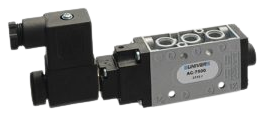
Directional control valves are essentially traffic cops for compressed air, directing flow where it needs to go and when. The numbering system (3/2, 5/2, etc.) tells you ports and positions – industry shorthand that every pneumatic tech learns early.
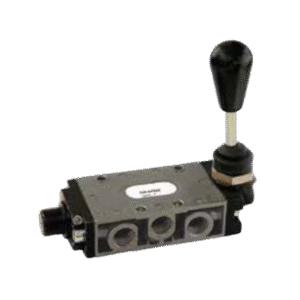
Spool valves use a machined cylinder that slides back and forth inside the valve body. Low friction means fast switching, which is why packaging lines love them. When you’re filling 2,000 bottles per hour, valve response time matters. Poppet valves take a different approach – spring-loaded elements that seal tight when closed. They’re bulletproof for leak-tight applications but won’t match a spool valve’s speed.
Flow control gets more nuanced than most people realise. Meter-in control (restricting air entering the cylinder) gives smooth starts but speed varies with load changes. Meter-out control (restricting exhaust flow) provides much better speed regulation, especially important when you need consistent cycle times regardless of what the actuator is pushing against.
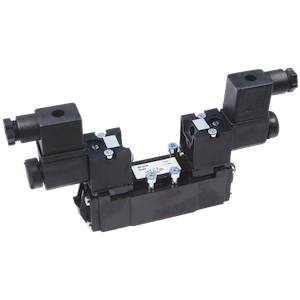
Pressure relief valves serve as the system’s safety net, preventing dangerous over-pressurisation that could cause component failure or injury. Quick exhaust valves, installed directly at actuators, dramatically improve cycle times by allowing rapid exhausting of large cylinder volumes without restriction through the main control valve.
Pneumatic Actuators: Converting Compressed Air into Mechanical Work
Pneumatic Cylinders come in two basic flavours: single-acting (air extends, spring returns) and double-acting (air both ways). Single-acting saves air and gives you fail-safe operation – lose air pressure and the spring pulls everything back to a safe position. Double-acting provides full force in both directions, essential when you need to push and pull with equal force.
Cylinder selection involves more than just “how much force do I need?” Long-stroke applications can run into rod buckling issues – you can’t just keep making the rod longer without beefing up the diameter. Side-loading is another issue; mount a cylinder at an angle to its load and you’ll wear out bushings and seals in much quicker.
Rotary actuators handle jobs where you need angular motion rather than linear. Rack-and-pinion types deliver serious torque with excellent positioning accuracy. Vane actuators are more compact but limited in rotation angle – pick the wrong type and you could be redesigning your whole setup.
Choosing the Right Components for Your Application
Component selection determines system performance, reliability, and total cost of ownership. Engineers must balance multiple factors including cycle requirements, environmental conditions, maintenance accessibility, and safety considerations.
High-Speed Packaging Applications: These demand fast-acting valves with minimal pilot air consumption and actuators designed for millions of cycles. Lightweight aluminium cylinders with precision-moulded seals reduce inertia while maintaining sealing integrity at high cycle rates. Flow control becomes critical for managing acceleration forces and preventing shock loads.
Food & Beverage Processing: Requires FDA-compliant materials, wash-down protection, and elimination of contamination sources. Stainless steel construction, food-grade lubricants, and IP67 protection ratings become standard requirements. Quick-disconnect fittings enable rapid disassembly for cleaning and sanitisation.
Mining and Heavy Industrial: Demands robust construction capable of withstanding extreme temperatures, vibration, and contamination. Heavy-duty steel cylinders with reinforced mounting, high-temperature seals, and oversized filtration systems ensure reliable operation in these challenging environments.
(For detailed specifications and selection guides, consult technical datasheets from established manufacturers who understand these demanding applications.)
Applications in Action: Real-World Pneumatic Solutions

Automated Packaging Lines
Modern packaging operations showcase pneumatic systems at their most sophisticated. A typical bottling line uses dozens of pneumatic actuators working in precise coordination. Product positioning cylinders orient containers with repeatability measured in fractions of millimetres. Capping stations use controlled-torque rotary actuators to apply closures with exact force specifications. Reject mechanisms use high-speed linear actuators to remove defective products from the line in milliseconds.
The key to packaging success lies in synchronised motion control. Programmable logic controllers coordinate valve actuation with photoelectric sensors and servo positioning systems, creating seamless product flow at speeds exceeding 1,000 units per minute.
Mining Material Handling
Pneumatic systems in mining operations must handle massive loads under extreme conditions. Conveyor belt tensioning systems use large-bore cylinders to maintain proper belt tension across temperature variations and load changes. Pneumatic vibrators break up material bridging in hoppers and chutes, preventing costly production stoppages.
Mine ventilation systems often incorporate pneumatic dampers and louvres that automatically adjust airflow based on atmospheric conditions. These systems must operate reliably in environments with high dust loads, temperature extremes, and constant vibration.
Safety and Maintenance: Ensuring Long-Term Reliability
Lockout/Tagout procedures for pneumatic systems require special attention to stored energy. Unlike electrical systems that can be simply disconnected, pneumatic systems retain pressure in cylinders, reservoirs, and connecting lines. Proper isolation requires closing supply valves, exhausting system pressure, and physically blocking energy sources.
Pressure testing should never exceed rated system pressures, and testing should always be conducted with proper safety barriers in place. A catastrophic failure of a pneumatic component can release energy equivalent to a small explosive device.
Preventive maintenance programmes should include regular inspection of air treatment components, with filter elements replaced based on pressure differential rather than arbitrary time intervals. Regulator accuracy should be verified periodically, as spring fatigue can cause pressure drift over time. Actuator alignment and mounting should be checked during scheduled maintenance, as misalignment accelerates wear and increases air consumption.
Leak detection using ultrasonic equipment can identify energy waste that significantly impacts operating costs. A single 1mm leak at 6 bar pressure wastes approximately 11.5 CFM of compressed air – equivalent to nearly 1kW of compressor power operating continuously.
Proper system design, and selection of quality components purchased from a reliable and experienced supplier and systematic maintenance programs ensure pneumatic systems can deliver decades of reliable service while maintaining peak performance efficiency.
The investment in quality components and professional installation pays dividends through reduced downtime, lower energy costs, and improved safety performance.
About this Guide:
This resource is developed by Mastermac2000 a leading process control pneumatics parts and components supplier, based in Brisbane, Queensland. MasterMac2000 has served this industry since 1989.
This guide references general industry information and practices, however specific componentry selection should always start with a consultation with qualified engineers who are familiar with your applications’ requirements – our team are well qualified to assist.
Contact Mastermac 2000’s experts with experience specifically in industrial pneumatic components supply since 1989. Call 07 3344 4711 or contact us online here

About MasterMac2000: Your Trusted Pneumatic & Process Automation Partner.
LEADING THE INDUSTRY: Established in 1989, MasterMac2000 has grown to become one of Australia's largest privately owned pneumatic and process automation companies. We stock top-quality brands like Univer, Mack, Tolomatic, Mac, Piab, American, and Rotoflux in Brisbane.
SERVING QLD & NORTHERN NSW: We proudly service Queensland and Northern New South Wales for all your pneumatic and process equipment needs. Our mission is to provide the best pre and post-sales support while actively expanding our client base.
SOURCING HARD-TO-FIND PARTS: Not only do we stock quality components, but we also excel at sourcing those elusive, hard-to-find parts. With our extensive database and global network of contacts, getting the parts you require is as easy as a call to our highly skilled, professional sales team.
DEDICATED TO YOUR SUCCESS:
- Decades of expertise in pneumatics & process automation
- Carefully curated selection of world-class brands
- Exceptional sourcing capabilities for speciality parts
- Knowledgeable sales staff dedicated to finding solutions
- Unwavering commitment to customer service excellence
About The Author
Stuart Havill
Stuart Havill is the owner and manager of MasterMac2000, Queensland's largest privately owned pneumatic and process valve company.
With his early working career as a maintenance fitter for Boral in 1992, Stuart has spent his life in the field of pneumatics and process equipment. He gained extensive experience in plant design, maintenance, repairs, fabrication, and site management.
In 1996, he transitioned to a pneumatic sales technician role at MasterMac2000, where he excelled in key account management, providing cost-effective solutions, and managing a sales team of 9 employees.
Since 2002, Stuart has been the manager at MasterMac2000, overseeing the company's growth and establishing it as a leader in pneumatic automation and process valve engineering. His expertise spans customer training, CRM setup, industrial compressor sizing and installation, and turn-key project management.
Under Stuart's leadership, MasterMac2000 has been servicing the industry since 1988, with 5 full-time sales representatives covering northern rivers NSW, Queensland, Northern Territory, and PNG. The company prides itself on providing the best-priced solutions to all customers in the marketplace.
View Stuart’s LinkedIn profile to learn more about his expertise in pneumatics and process equipment.