
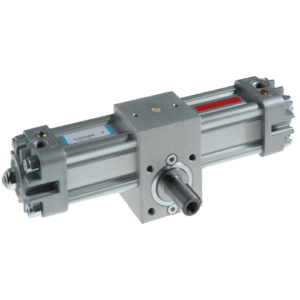
Pneumatic Rotary Cylinders
Univer’s rotary cylinder products are incorporated with the latest of the several technology features, which means higher degree of accuracy and reliability during the application. Such tools include pneumatic rotary actuators and rotary tables.
Description
Pneumatic Rotary Cylinders
Univer Rotary Cylinders: Precision Rotary Actuation for Industrial Applications
Rotary cylinders convert compressed air into controlled angular motion, providing the turning, indexing, and positioning movements that linear cylinders cannot achieve. Where a standard pneumatic cylinder pushes or pulls in a straight line, a rotary cylinder rotates a shaft through a defined arc, typically between 90 and 360 degrees.
These actuators appear throughout industrial automation: turning parts between workstations, operating quarter-turn valves, rotating conveyors, flipping components for inspection, and driving mixing mechanisms. Their ability to deliver high torque in a compact package makes them valuable wherever rotational motion must be pneumatically controlled.
MasterMac 2000 supplies Univer TecnAir rotary cylinders, a range engineered for precision and durability across demanding industrial environments. This page explains how rotary cylinders work, the types available, and how to select the right model for a given application.

How Do Rotary Cylinders Work?
A rotary cylinder converts the linear force of compressed air into rotational torque. The most common mechanism for achieving this conversion is the rack and pinion system.
Inside a rack and pinion rotary cylinder, one or two pistons travel linearly within the cylinder housing. Each piston has gear teeth (the rack) machined into its surface. These teeth mesh with a central circular gear (the pinion) that connects to the output shaft. When compressed air drives the piston forward, the rack’s linear movement rotates the pinion, which turns the output shaft.
In double-acting designs, air pressure can drive the piston in either direction, providing powered rotation both clockwise and anticlockwise. Reversing the air supply to the opposite port reverses the direction of rotation. Single-acting models use air pressure for rotation in one direction and a spring for return.
The torque output depends on the piston area, air pressure, and the radius of the pinion gear. Larger bore sizes and higher operating pressures produce greater torque. Because the rack and pinion mechanism maintains constant leverage throughout the stroke, torque output remains consistent across the full rotation range, unlike cam-driven mechanisms where torque varies with position.

What Are the Different Types of Rotary Actuators?
Rotary actuators fall into two main categories based on their operating mechanism: rack and pinion types and vane types. Each has characteristics that suit different applications.
Rack and Pinion Rotary Actuators
Rack and pinion actuators use the gear mechanism described above. They excel in applications requiring high torque, precise positioning, and repeatability. The gear engagement provides positive drive with minimal backlash when properly manufactured, and the design scales effectively from small units producing a few Newton-metres of torque to large industrial actuators delivering thousands of Newton-metres.
These actuators typically offer rotation ranges from 90 to 360 degrees, with some models providing adjustable end stops for setting precise rotation limits. Their robust construction suits heavy-duty applications and harsh environments. The trade-off is that rack and pinion units tend to be larger than vane-type actuators of equivalent torque rating.
Vane Type Rotary Actuators
Vane actuators work differently. A rigid vane attached to the output shaft sits inside a cylindrical chamber. Compressed air enters on one side of the vane, pushing it around within the chamber and rotating the shaft. The vane connects directly to the output shaft with no intermediate gears.
This direct-drive arrangement produces smooth, continuous motion and allows for very compact designs. Vane actuators respond quickly and work well in applications requiring rapid cycling. However, they generally produce lower torque than rack and pinion actuators of similar size, and their rotation is typically limited to 280 degrees maximum for single-vane designs (less for double-vane models that trade rotation range for increased torque).
Vane actuators suit light to medium-duty applications where compactness and speed matter more than maximum torque: damper control, valve positioning, robotic joints, and transfer mechanisms handling moderate loads.
TecnAir Rotary Cylinder Range
TecnAir rotary cylinders incorporate refined rack and pinion engineering for industrial precision applications. The range includes four main series, each designed for particular operating requirements.
R-Series General Purpose Actuators
The R-Series provides robust rotary actuation for common industrial tasks. Bore sizes range from 32 mm to 125 mm, with rotation angles from 90 to 360 degrees. These actuators suit conveying systems, folding mechanisms, valve automation, and general material handling where reliable performance matters more than extreme precision or torque density.
R22/R23 High Load Rotary Tables
The R22 and R23 series feature precision bearings rated for high axial and radial loads. With bore sizes from 15 mm to 40 mm and rotation up to 190 degrees, these units suit rotary table applications where the actuator must support the weight of workpieces and tooling while maintaining positional accuracy. The bearing arrangement handles the side loads that would damage standard rotary actuators.
R30 Compact Series
Where installation space is limited, the R30 series delivers substantial torque from a reduced envelope. Available in 50 mm, 63 mm, 80 mm, and 100 mm bores with 90 or 180 degree rotation, these compact actuators fit into tight machine layouts without compromising performance. They suit packaging machinery, assembly fixtures, and automated workstations where every millimetre of space counts.
E-Series Electric Rotary Actuators
For applications where compressed air is unavailable or undesirable, the E-Series provides electric rotary motion with IP67 protection for washdown environments. Operating voltages range from 24V to 230V across bore sizes from 32 mm to 80 mm. Corrosion-resistant construction and sealed enclosures make these units suitable for food processing, pharmaceutical manufacturing, and outdoor installations.
What Are Rotary Cylinders Used For?
Rotary cylinders appear wherever angular motion must be pneumatically controlled. Common applications include the following.
Valve automation is one of the most widespread uses. Quarter-turn valves such as ball valves and butterfly valves require 90-degree rotation to open and close. A rotary actuator mounted directly to the valve stem provides this motion without linkages or lever arms, with torque output matched to the valve’s operating requirements.
Part transfer and orientation systems use rotary cylinders to flip, turn, or index components between processing stations. A workpiece might need rotation for machining on multiple faces, or components might require turning to present the correct surface for labelling, inspection, or assembly.
Conveyor diverters and transfer mechanisms employ rotary actuators to swing gates, deflectors, or transfer arms that route products along different paths. The defined rotation angle and positive positioning of a rotary cylinder ensure reliable, repeatable diversion.
Clamping and gripping systems sometimes use rotary motion to swing clamp arms into position or to rotate gripper assemblies. Rotary actuators integrated into end-of-arm tooling on robots provide wrist rotation for pick-and-place operations.
Mixing and stirring applications benefit from oscillating rotary motion. The actuator swings back and forth through a defined arc, agitating contents without continuous rotation that would require slip rings or rotary unions for air supply.
How Do You Select a Rotary Cylinder?
Choosing the right rotary cylinder requires matching actuator capabilities to application demands. Several factors determine the appropriate selection.
Torque Requirements
Calculate the torque needed to rotate the load, accounting for friction, inertia, and any external forces acting on the mechanism. Add a safety margin of 25 to 50 percent above the calculated requirement. Manufacturers publish torque values for each actuator size at various operating pressures. Remember that torque on the return stroke may differ from the extend stroke in single-acting models due to spring force characteristics.
Rotation Angle
Determine the required rotation range. Standard options include 90, 180, and 360 degrees, with many actuators offering adjustable end stops for setting precise intermediate angles. For quarter-turn valve applications, 90 degrees suffices. Part flipping typically requires 180 degrees. Full rotation or indexing applications may need the maximum available angle.
Speed and Cycling Rate
Consider how quickly the actuator must complete its rotation and how many cycles per minute the application demands. Port size affects flow rate and therefore rotation speed. High-speed applications may require flow controls to prevent excessive velocity and the shock loads that result from abrupt stops. Internal cushioning, available on many models, decelerates the rotation near end stops to reduce impact.
Mounting and Load Support
Standard rotary actuators handle rotational loads but may not tolerate significant axial or radial loads on the output shaft. If the application applies side loads or the actuator must support weight, select a model with appropriate bearing arrangements, such as the TecnAir R22/R23 high-load series. For mounting flexibility, check available interface options against the equipment’s requirements.
Environmental Conditions
Operating temperature, exposure to moisture, corrosive atmospheres, and washdown requirements all influence material selection. Standard aluminium housings with anodised finishes suit most industrial environments. Food processing, pharmaceutical, and marine applications may require stainless steel construction or special seals. Check temperature ratings against the expected operating range, particularly for applications near ovens, furnaces, or refrigeration equipment.
Technical Specifications
TecnAir rotary cylinders are manufactured to the following general specifications, with variations by model series.
Bore sizes range from 15 mm to 125 mm across the product range. Rotation angles span 90 to 360 degrees depending on model. Operating pressures for pneumatic models run from 1.5 to 10 bar. Temperature ratings cover -20°C to +80°C for standard seals.
Construction features include extruded aluminium housings with anodised finish, square-profile rack and pinion gears for reduced backlash, and precision roller bearings supporting the output shaft. Pneumatic or mechanical cushioning provides controlled deceleration at rotation limits. Adjustable end caps allow infinite angle selection within the actuator’s range.
Mounting interfaces comply with ISO 5211 standards for direct valve mounting where applicable. Port and thread configurations accommodate standard pneumatic fittings. Dual pinion configurations are available for higher torque requirements.
Detailed datasheets and 3D CAD models for each TecnAir series are available through MasterMac 2000, providing complete dimensional, performance, and mounting information for design integration.
Should You Choose Rack and Pinion or Vane Type?
The choice between rack and pinion and vane-type actuators depends on application priorities.
Choose rack and pinion actuators when the application requires high torque output relative to actuator size, rotation angles up to 360 degrees, precise and repeatable positioning, long service life in demanding conditions, or the ability to handle heavy loads.
Choose vane-type actuators when the application prioritises compact installation envelope, fast response and high cycling speeds, smooth continuous motion, lower cost for light-duty applications, or moderate torque requirements with rotation under 280 degrees.
For most industrial automation applications involving valve control, material handling, and workpiece positioning, rack and pinion actuators provide the torque capacity and durability that production environments demand. The TecnAir range from Univer covers this territory comprehensively.
Maintenance and Troubleshooting
Rotary cylinders require minimal maintenance when supplied with clean, dry, properly regulated air. The same air quality principles that apply to linear cylinders apply here: filtration removes particulates that accelerate seal wear, and moisture removal prevents internal corrosion.
Periodic inspection should check for air leakage at shaft seals and body joints. Gradual loss of speed or torque may indicate seal deterioration or internal wear. Increased backlash in positioning suggests gear wear and may warrant actuator replacement.
If the actuator fails to reach full rotation, check for mechanical obstructions, verify that supply pressure meets specifications, and confirm that flow controls are not excessively restricted. Erratic or jerky motion often results from contaminated air supply, inadequate flow capacity, or worn cushioning components.
Technical Support and Supply
TecnAir and Master Mac 2000 bring decades of experience in rotary actuation to their product designs. Through continual refinement based on real-world application feedback, the range delivers the balance of precision, robustness, and configurability that industrial environments require.
As an authorised Univer distributor in Queensland, MasterMac 2000 stocks TecnAir rotary cylinders and provides technical support for selection, sizing, and system integration. Whether the application involves valve automation, workpiece positioning, conveyor control, or custom machinery, our team can advise on the appropriate actuator configuration.
For enquiries about TecnAir rotary cylinders, technical specifications, or assistance selecting the right actuator for your application, contact MasterMac 2000. With over 35 years supporting industries throughout Queensland and Northern New South Wales, we provide the product knowledge and local stock access that keeps your automation systems running.
